It has been one of those months. The purple petals are fading on the jacaranda trees, which means summer is officially here, and I can’t read without growing restless. I have a rigid schedule these days: up at five to work on my novel, an hour break around eleven, and then to work editing until six. When I’m done, I eat dinner, and then reach for something to read. But nothing is working. Half a dozen books are sitting half-read (or less, or more) on my nightstand. Pilgrim at Tinker Creek. The Elegance of the Hedgehog. An Illuminated Life. Main Street. The Easter Parade. The Golden Notebook (just two chapters to go, and somehow I can’t do it). I open each book, read a paragraph or two, and then flip on my computer to watch an episode of Barney Miller on Hulu before going to bed, just so I can get up and start all over again.
I missed being devoured whole by a book, and so on Saturday I decided to walk to the new Goodwill on Beverly and buy a book that would consume me. I put my trust in serendipity. I walked in, got distracted by the racks of jeans, and wasted time searching for old Levi’s for a while before making my way to the bookshelf. I scanned the volumes. Lovely Bones came as no surprise. When does it not show up in a thrift shop? Imagining Argentina did. What a powerful story. But I had already read it. I was distracted for a moment by the realization that Goodwill’s are where Reader’s Digest condensed books go to die.
Then I found, side by side, two editions of Peter Carey’s My Life as a Fake. A British version and an American version. I know of his books. I have always been meaning to read him, though I assumed it would be something more obvious, like Oscar and Lucinda or True History of the Kelly Gang. But these paired paperbacks seemed like a sign, especially since the book was about literary folly and Asia, two of my favorite subjects. I liked the cover of the British version better, but I didn’t like its paper and typeface. The American version had a slight tear in its back cover, but the paper felt nicer, and the type was bigger. I chose the American version.
Back outside, I walked to the post office, and to the library to return three of the partially read books. From there I headed up First toward Starbucks to get an iced green tea. I opened My Life as a Fake and read the first paragraph. I read the second. I read the third. Reading and walking in the dead heat of midday, passing in and out of the shade of the magnolia trees. It was one of those bluest of blue days when shadows feel like pools of cool water. I was beyond the noise of the main streets. I could hear the breeze in the palms high above as words like “territorial enthusiasm” drifted from the page.
It was the kind of book that leapt right in. Just what I needed. I read on until I hit Starbucks, and held my place with my thumb as I ordered my iced tea. The barista asked me what I was up to that day.
“Walking and reading,” I told him.
He considered this and seemed confused. He said, “Good thing you’re doing it in this neighborhood. You couldn’t do that in just any neighborhood in L.A.”
This was true, for more than one reason. I most likely wouldn’t get mugged here (although I have been mugged in a better neighborhood than this one), and the sidewalks were relatively smooth. Very little tripping as I read and walked. Past the New Beverly Cinema. Past the medieval crenellations of Lloyd Klein Couture, with its turtle pond out front. I marked my place again to take a moment to watch the turtles, necks arched, little pointed faces arched toward the sun. As I read about a prank involving a poet called Bruno Hat, I overheard two homeless men in a bus shelter discussing whether or not Michael Jackson had been abused as a child. I walked home, book in hand, took out the dog, book in hand, and then perched on the arm of my sofa, book in hand, still reading.
As I blow dried my hair, I wandered through Kampong Baru market. As I ate dinner, I listened to a man named Christopher Chubb try to convince the editor of a literary journal of the authenticity of a particular poem. I like hiding away from the world and reading for hours. I also like living while a book is living. Not just to be absorbed by it, but to live with it, as it lives, as I did as a child, cleaning my room with Little Women propped open, dirty socks and Jo’s dreams of being a great writer and chaotic school papers and Beth’s dying all one. As evening came, I was only a third of the way through My Life as a Fake, but I had plenty more to do before bedtime. I would water my plants, I would dust, and I would take the dog for another walk. Reading all the while.
Tuesday, July 14, 2009

Sunday, May 24, 2009
City of Ghosts

I just got back from a month in Asia, a week of which I spent in Cambodia. My friend Janet and I traveled to the northeast, to Kratie, where I took off by myself around seven each morning for days spent bicycling along the Mekong River, past simple timber houses built on stilts, around an island filled with cows and haystacks, and up and down Kratie’s riverfront promenade at sunset. It was peaceful. It was beautiful. I could have stayed longer, until the ennui of small town life set in and I felt the urge to move on.
From Kratie we took an eight-hour bus ride to Phnom Penh, which I had been looking forward to visiting for ages. Not only because of a novel I was researching, but because I had been there in 1997, right after the Hun Sen coup that ousted the prime minister. During that first trip there was a tension simmering just beneath the surface. The coup was so fresh that some of the windows were still shot out at the airport when I arrived. But there was also a warmth that swam among the quiet, dusty city streets like sunlight in the current of a dark river. Phnom Penh felt in a state of limbo back then, the past not forgotten—nothing that terrible can be forgotten—but in the process of being let go, and the future still to come. Any future. That was the beauty of it. Coming back, I was excited to see the direction it had taken, envisioning a place in which ancient Khmer artistic traditions were revived and evident in daily life, the French architecture restored, and the mood one of conciliation among a resurrected population.
My heart broke. The city was dingy and aggressive, its streets clogged with cars and filthy exhaust fumes. Its energy was cheerless. I was only back for a few days, so I realize my experience was limited, but in that short time I saw three street fights and not a single person laughing. Not in a shop, not in a restaurant, not at a sidewalk street stall. I saw none of the modest promise that I remembered. The once beautiful waterfront had become just another backpackers’ free-for-all of happy hours, beggars and desperate motorcycle drivers. Protecting children from pedophiles is a national campaign. So many of the old French buildings looked as if they should be condemned. The only thing that felt cared for was the National Museum, full of Khmer art, and that was where I spent most of my days.
When I did wander the streets of Phnom Penh, I searched for a glimpse of people enjoying themselves but instead saw lethargic street vendors and a man in a suit get out of a Lexus SUV and pee on the wall across from the Royal Palace. Often, the movie City of Ghosts crossed my mind. I saw it when it came out in 2003. On the surface it is a basic thriller. Matt Dillon plays a front-man involved in a kind of Ponzi insurance scheme. When claims following a hurricane reveal the scam, the Feds come down on him, so he heads to Cambodia to find his boss, played by James Caan, who is trying to invest in a casino while hiding out from some angry Russians.
What I liked about the movie the first time I saw it was what a fine job Dillon, who also directed, did with the atmosphere. I had lived just across the border in Vietnam for four years, and I felt that he really got that part of the world, from the color of daylight at certain times of day to the flicker of fluorescent lights in a room at night to the faded elegance of the floor tiles to the people—he portrayed without parodying young Vietnamese women forced into prostitution, dazed pill-popping travelers, a beautiful do-gooder, a good-hearted but practical cyclo driver, and the French innkeeper played brilliantly by Gerard Depardieu, who wrests a knife from a man’s hand while balancing his half-Cambodian toddler on his hip. I also felt that Dillon captured a moment in time. The last days of the Wild West. But watching the movie after my recent trip, I saw it as a chronicle of why Cambodia has the odds stacked against it.
I’m not saying that Matt Dillon is a sage, but he certainly illustrated the players in a tragic path of least resistance. The corrupt but realistic Cambodian general who will always put himself and money before his country. The foreigner (Caan) who does not see himself as opportunistic or greedy, but rather practical in his own way as he shreds a country’s culture and belittles its dignity in pursuit of the big buck—most dangerously when it is disguised as "the name of progress." Mostly, though, Dillon caught the thoughtless violence that is bred by a legacy of thoughtless violence.
During my recent trip, my friend and I had dinner with a Cambodian man in his early twenties, charismatic, fluent in English, with every foreigner who has ever met him rooting for him to succeed. As the evening progressed and the small talk gave way to real conversation, we talked about whether the city is dangerous or not, and he said he didn’t think so before telling us how that when he and his friends caught a guy who had been robbing travelers, they bashed his head in with a rock. It was unclear whether or not the robber survived.
A country’s youth is its hope. Is this Cambodia’s hope? A child of Khmer Rouge survivors who spent his boyhood on the streets, begging and then selling newspapers. A young man who waits for his brother the tuk-tuk driver to get off work every night so that they can go home together—safety in numbers. He seemed to have little understanding of the brutality his parents must have suffered, but a very real—and nonchalant—street knowledge of the endowment that brutality had bequeathed. It is the nonchalance that concerns me.
Sitting there in a country in which an entire generation of thinking people had been eradicated, in a city that has its own killing fields, at a table with a polite young man who thought nothing of the vigilante punishment of another human being, I wondered what there was left to hope for. I hope that the young man finds the promise that lies within him. I hope that City of Ghosts becomes a time capsule. But mostly I hope that I am wrong and that the future—a generous, life-affirming future—is still to come to the sad faded streets of Phnom Penh.
Friday, March 6, 2009
For the times, they are a-changin'
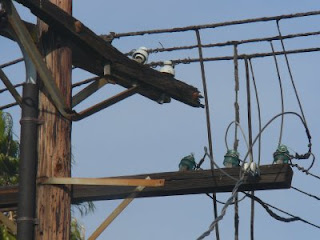
For the past nine years---the longest I've lived anywhere---I have been writing at a desk in the back of my apartment that overlooks my neighborhood's old Spanish-style buildings and the Hollywood sign. It also overlooked two palm trees and an old power pole that captivated me the first time I saw it. I could never get enough of the view ... bright blue days, windy days, rainy days, the smoky, hazy, unreal days of the Griffith Park and San Diego fires. I've watched squirrels hang precariously off the pole, and birds cluster on it. When I wasn't able to find the right words, I stared at it for hours. And then, last week, the worst thing imaginable happened. I noticed a couple guys working on the pole. The next thing I knew, the decades' old power box and beautiful blue glass thingies (sorry, I don't know the technical terms) were gone, and in their place a new, ugly cylinder that I'm sure is safer and more efficient, but that breaks my heart every time I look at it. I'm not sure that I want to live here anymore. In pictures, an ode to my writing life since 2000 ...




Subscribe to:
Posts (Atom)

